
Many packaging companies advertise a zero-unit minimum by printing exclusively on digital presses. Digital printing is a reasonable choice for short runs of simple packaging, but cereal boxes are rarely simple: they combine dense full-color artwork, fine halftone photography, and precise brand colors that need to match exactly from the first case to the ten-thousandth. Offset printing holds color and detail more consistently across a run than digital, which is why it remains the standard for retail cereal packaging at any real production scale.
Our 100-unit minimum reflects the cost of setting up offset plates, spread across a small enough run that a new brand can still order a real first batch, test retail placement, or launch a limited flavor without overcommitting. It is a fraction of the 1,000 to 5,000-unit minimums common at traditional offset box manufacturers, while still giving you the color precision that digital-only, zero-minimum printers cannot consistently match at cereal box scale.
Retail cereal packaging is a two-part system, and the box you print is only half of it. The outer paperboard carton provides shelf structure, branding, and the surface for all required FDA labeling. An inner liner bag, typically polyethylene, foil-laminated film, or a biodegradable PLA film, is the layer that actually touches the cereal and blocks the moisture and air that cause it to go stale or soft.
This matters when you are specifying your box: the carton keeps its shape and looks good on the shelf, but freshness is a function of the liner bag, not the paperboard. We design cartons that fit your liner correctly, since an oversized liner compresses and wrinkles inside a tight carton, and an undersized one leaves excess air space that speeds up staling.
The most common and cost-efficient cereal carton style, with top and bottom flaps that tuck and lock without adhesive. Fast to run on automated filling lines, which makes it the default choice for standard retail cereal.
Flaps tuck in opposite directions on the top and bottom, giving a stronger, more tamper-resistant closure than a straight tuck. A good option for heavier cereals or family-size boxes that take more handling stress.
A glued, self-forming base that locks flat without manual folding, adding extra strength at the bottom seam. We recommend this for bulk and family-size boxes, where the added base strength matters most under the product’s own weight.
A peaked, carry-handle top structure that stands out visually from standard rectangular cartons. Used more for differentiated retail positioning, limited editions, or gifting formats than for everyday high-volume SKUs.
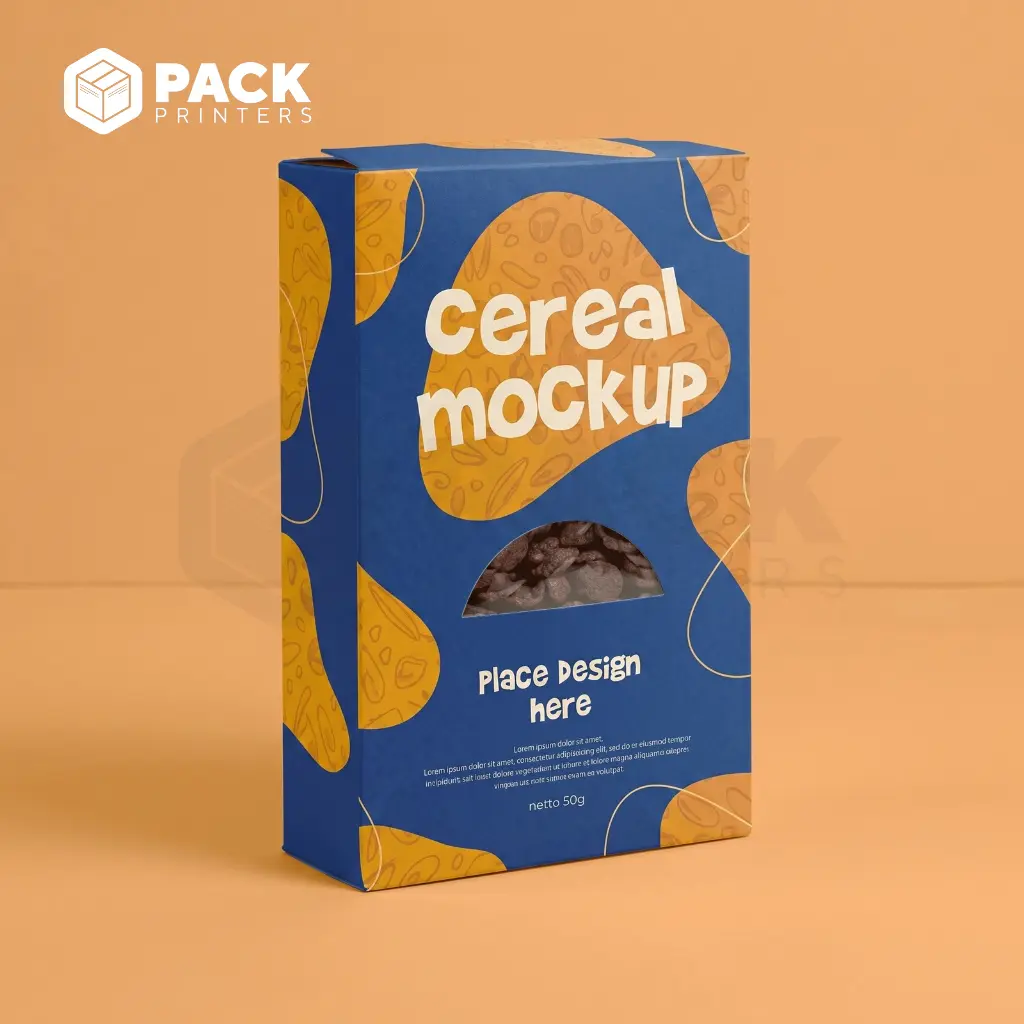
A tuck or auto-lock carton with a die-cut window over the liner bag, letting customers see the cereal or granola clusters inside. Effective for premium or ingredient-forward products where visible texture supports the sale.
Format |
Typical Height |
Best For |
Single-serve / mini |
4″ to 6″ |
Sample sizes, foodservice, subscription boxes, kids’ lunch packs |
Standard retail |
10″ to 12″ |
Most grocery shelf cereal, aligned to standard shelf spacing and planograms |
Family / bulk size |
12″ and up, wider footprint |
Value multipacks, club store formats, higher fill weights |
Standard retail cereal boxes cluster in a fairly narrow height range because shelf spacing, case packing, and pallet efficiency are all built around it. If you are developing a new SKU, matching this standard footprint, rather than a fully custom size, usually keeps case and pallet costs down without limiting your design.
Material |
Best For |
SBS paperboard (coated boxboard) |
Standard retail cartons; smooth surface for offset color and photography |
Bux board (recycled boxboard) |
Family and bulk-size boxes needing extra base and wall strength |
Kraft board |
Natural, artisanal-positioned brands and granola or health-food lines |
Corrugated |
Outer shipping cases and bulk shippers, not the retail-facing carton itself |
This is the part of cereal packaging most printing companies treat as an afterthought, and it is where a design can get rejected at the retail or co-packer level if it is not planned correctly. The FDA regulates the Nutrition Facts panel closely, including minimum font sizes that scale with package size and cannot be reduced to fit a smaller layout, along with required daily value percentages calculated against current FDA reference values.
A compliant cereal box also needs a full ingredient list, allergen declarations, the manufacturer’s name and address, a UPC barcode with a clear quiet zone around it, and space for batch or lot codes and an expiration date. If your brand carries USDA Organic or Non-GMO Project Verified certification, those marks have their own placement and sizing rules to follow correctly.
We lay out dedicated, correctly proportioned space for every required panel during the dieline stage, before final artwork is built, so your Nutrition Facts panel is not squeezed in as a last step. Final legal responsibility for label accuracy and regulatory compliance rests with the brand selling the product, so we recommend having label copy reviewed against current FDA requirements before your first production run.
Offset printing gives us tight registration and consistent Pantone color matching, which matters most on a cereal box because mascot characters, logo colors, and food photography all need to look identical case after case. Finishing options include:
Freshness is a liner decision more than a carton decision, but the carton still has a job to do: it needs to hold its shape through warehouse stacking, survive automated case packing, and keep the top tuck flap functional through repeated opening and closing at home. We calibrate wall thickness and flap design to your product’s fill weight, so a family-size box carrying more cereal gets a sturdier structure than a single-serve carton.
For the liner itself, standard polyethylene film handles most cereal freshness needs at a lower cost, foil-laminated liners give the strongest moisture and oxygen barrier for premium or longer-shelf-life products, and biodegradable PLA liners suit brands prioritizing compostability over maximum barrier performance. We can help you weigh that tradeoff based on your product’s fat content and target shelf life, since higher-fat cereals and granolas are more prone to oxidation and typically benefit from the stronger barrier liner.
SBS paperboard, bux board, and kraft cartons are all widely recyclable through standard curbside paper streams once separated from the liner bag. The liner is the harder sustainability question: standard polyethylene liners are not curbside recyclable in most areas, while PLA liners are compostable only through industrial composting, not backyard composting or standard recycling. We can walk you through liner options if a specific sustainability claim, such as recyclable or compostable packaging, is part of your brand positioning, since the claim needs to match what you are actually shipping.
Pack Printers builds cereal packaging that holds its color, its shape, and its compliance information correctly, at a minimum order low enough for a new brand to actually use. Send us your cereal type, target size, and launch timeline, and our team will recommend the structure, material, and liner built for how your product will actually be sold.
Contact Pack Printers today for a free consultation and quote on your custom cereal boxes.
Free Design Support
Free Custom Box Dieline
Free Shipping