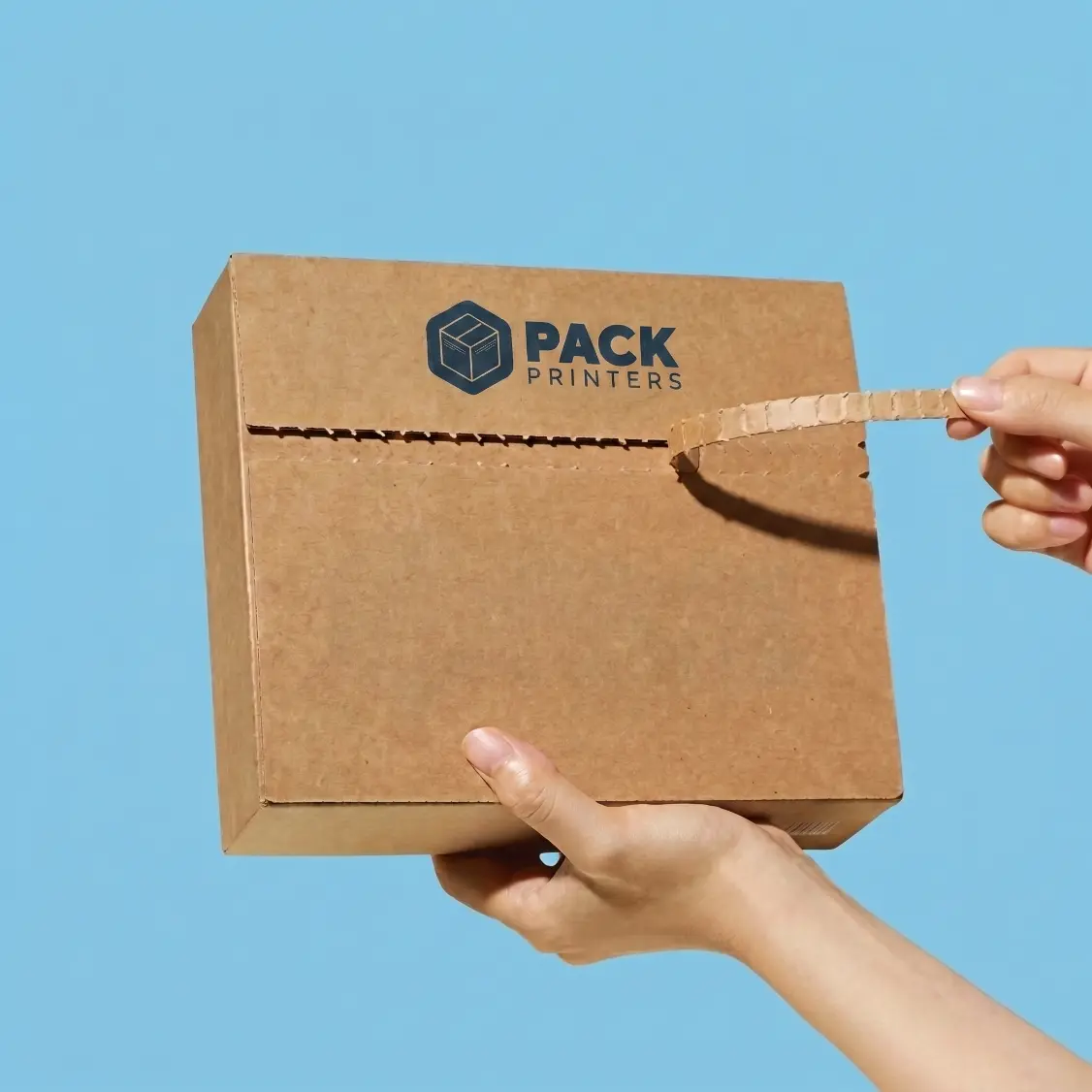
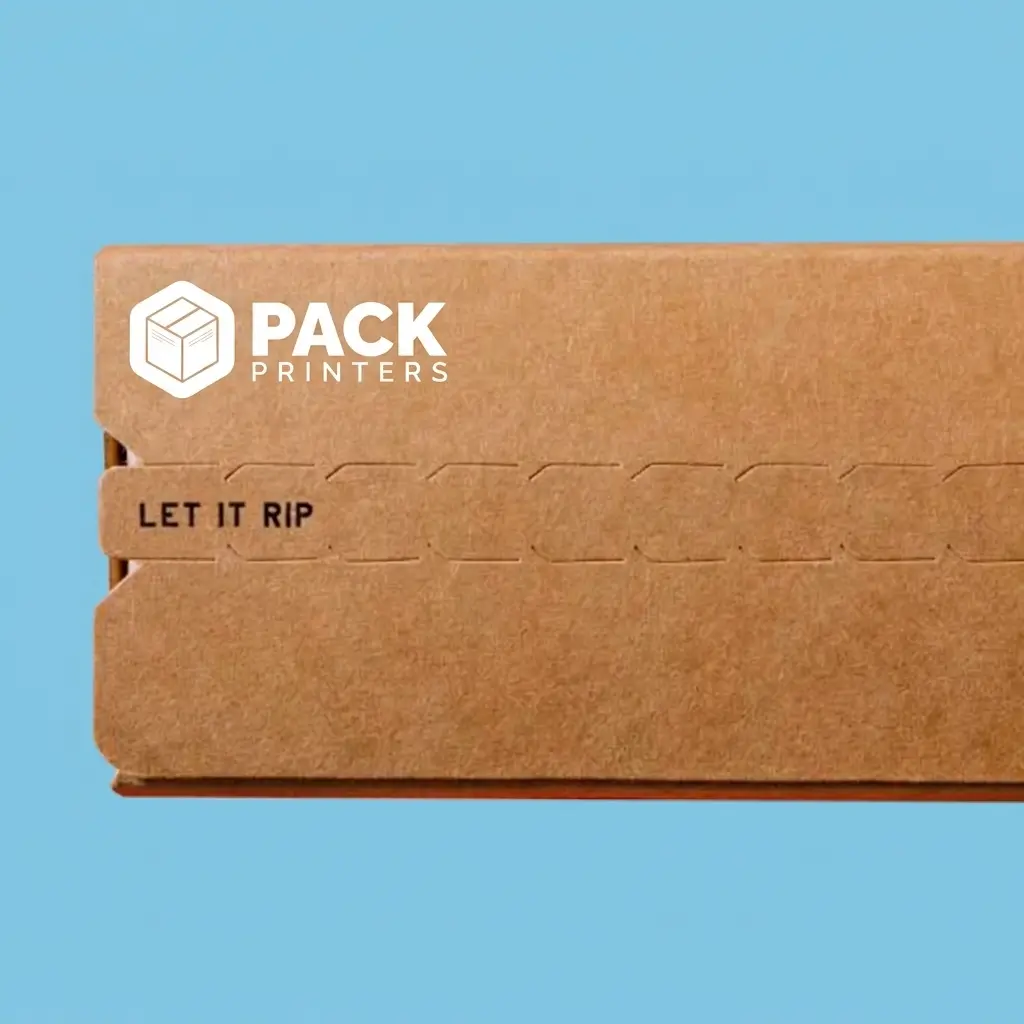

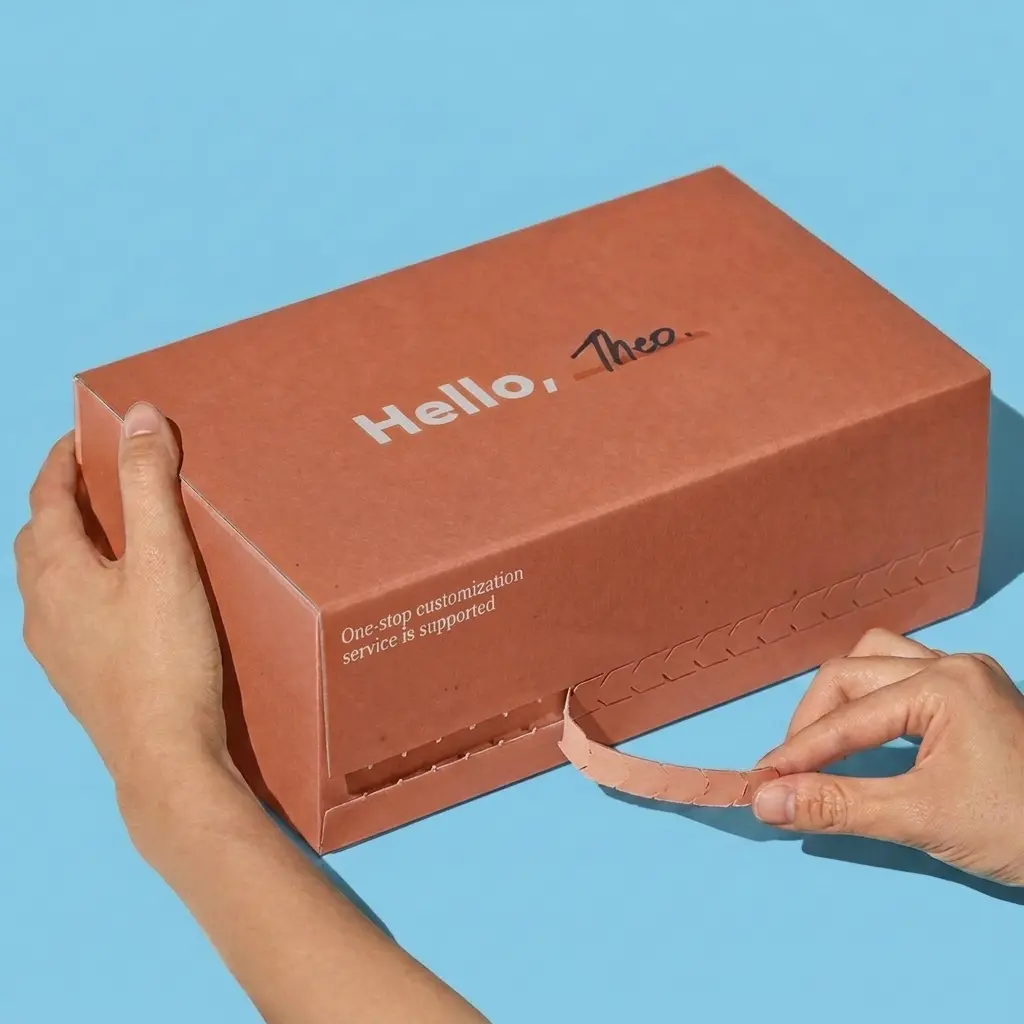
Tear strip packaging refers to boxes built with a reinforced strip, either laminated beneath the box surface or bonded directly onto it, that lets someone open the package by pulling instead of cutting. The strip is stronger than the board around it, so when it is pulled, it tears a clean, controlled line through the packaging rather than tearing raggedly or stopping short.
You will also hear this feature called a tear tape, rip strip, pull tab strip, or easy-open strip. The mechanism is the same across those names: a length of film, kraft, or reinforced paper tape applied along the exact path the box needs to open, so a single pull separates the flap, lid, or panel cleanly.
It shows up most often on food cartons, cosmetics and beauty boxes, pharmaceutical and supplement packaging, e-commerce mailers, subscription boxes, and retail cartons, anywhere a brand wants opening to be fast, tidy, and, in many cases, visibly tamper evident.
A tear strip is a length of tape, usually polypropylene film, kraft paper, or a reinforced paper laminate, adhered along the interior or exterior surface of the box with a pressure-sensitive adhesive. The tape’s own tear resistance is engineered to be lower along its width than the surrounding board’s resistance across that same line. Pull the exposed tab, and the tension concentrates along the strip’s edges instead of spreading across the whole panel, so the board fails in a straight, predictable line instead of tearing wherever it happens to be weakest.
One detail almost no packaging site explains, and one worth knowing before you finalize a design: tear direction matters. A strip performs best when the pull follows the exact direction it was engineered for. Most strips tolerate a deviation of roughly 30 degrees off that line before the tear starts to wander or the load becomes uneven on one edge of the tape. We account for this in the dieline and in where we position the pull tab, so the strip tears true even when a customer does not pull perfectly straight.
Strip width is a functional decision, not a cosmetic one. Narrower strips, in the 1.5 to 4 millimeter range, suit lighter cartons and envelopes where a fine, low-profile line is preferred. Wider strips, up to 15 to 20 millimeters, are better matched to heavier corrugated walls and double-wall board, where a broader adhesive path is needed to guide a clean tear through thicker material. We size the strip to your board caliper during the design stage so it performs correctly the first time, not after a reprint.
Where the strip sits on the box changes both how it opens and what it communicates to the customer. We build to four placement styles, and can also design a custom path around unusual box geometry.
The strip runs across the top of the box, typically along the main closure flap. This is the standard for subscription boxes, retail cartons, and shipping mailers because it is fast to open and familiar to the customer.
The strip runs along a side wall, which suits boxes that are meant to open like a drawer or tray rather than lift from the top. Common on sleeve-and-tray packaging and some cosmetics sets.
The strip runs all the way around the box so the entire lid separates from the base in one pull. This is the strongest tamper-evident option we offer, since there is no way to reopen and reclose the box without the missing strip being obvious. It is a common choice for pharmaceuticals, supplements, and higher-value retail goods.
For boxes with irregular shapes, multiple compartments, or brand-specific opening sequences, we design the tear path to match your structural dieline rather than fitting your box to a standard template.
Material |
Best For |
Notes |
Corrugated (E-flute, B-flute) |
Shipping mailers, heavier products, subscription boxes |
Best strength-to-weight ratio; E-flute for lighter items, B-flute for added cushioning |
SBS paperboard, 12pt to 24pt |
Retail cartons, food packaging, cosmetics |
Smooth print surface, holds fine graphics and coatings well |
Kraft paper and kraft board |
Eco-positioned brands, food, gifting |
Natural, uncoated look; strong tear performance with visible fiber texture |
Rigid board (setup boxes) |
Luxury goods, electronics, jewelry |
Does not collapse flat; strip is typically placed on a magnetic or friction-fit lid seam |
The tear strip is a functional element, but the rest of the box is where your branding does the work. We print in full-color CMYK or matched Pantone spot colors, and offer the finishing options that make a tear strip carton feel like a considered product rather than a plain shipping box:
Tear strips are one of several ways to build easy opening into a box. Here is how they compare to the alternatives, so you can confirm it is the right fit before committing to tooling.
Feature |
How It Opens |
Tamper Evidence |
Best Fit |
Tear strip |
Pull a tab; strip tears a clean, straight line through the board |
Strong, especially full perimeter |
Mailers, retail cartons, food, pharma, subscription boxes |
Perforation line |
Push or pull along pre-weakened dotted cuts |
Moderate; can be reopened without obvious damage |
Coupons, sample panels, budget-conscious cartons |
Pull tab die-cut |
Lift a die-cut finger tab to release a flap or panel |
Low |
Sleeves, small retail boxes, simple cartons |
Zipper closure (bags/pouches) |
Pull apart an interlocking plastic track |
Low, but reclosable, which is the point |
Flexible pouches, resealable food and snack bags |
Adhesive tear tape |
Same mechanism as a tear strip, applied as standalone tape rather than built into the box structure |
Strong |
Envelopes, flexible film packaging, retrofit onto existing stock |
The short version: if you want the cleanest tear line and the clearest proof that a package has not been opened before it reaches the customer, a tear strip outperforms perforation and pull tabs. If you need the customer to reclose the package repeatedly, a zipper closure or resealable format is a better fit than any tear-based feature.
Industry |
Typical Application |
Food and beverage |
Cereal cartons, snack boxes, bakery cartons, beverage multi-packs |
Cosmetics and beauty |
Skincare cartons, fragrance boxes, gift sets |
Pharmaceuticals and supplements |
Tamper-evident cartons for OTC products, vitamins, and supplement lines |
E-commerce and subscription |
Shipping mailers, monthly subscription boxes, direct-to-consumer cartons |
Electronics |
Retail cartons and rigid boxes for accessories and small devices |
Retail and apparel |
Shelf-ready cartons, gift boxes, folding cartons for boutique and big-box retail |
Specification |
Typical Range |
Box sizes |
Fully custom, from small cartons around 4 x 2 x 2 inches to large shipping mailers over 24 x 24 x 24 inches |
Tear strip width |
1.5 mm to 20 mm, sized to board weight and caliper |
Board caliper (paperboard) |
12pt to 24pt SBS |
Corrugated flute |
E-flute for lighter items, B-flute for added protection |
Minimum order quantity |
Available from low run quantities for new brands up to full production volumes; ask about current minimums for your material |
Turnaround |
Standard production plus proofing time; rush options available on request |
If you are not sure which specification fits your product, our team will review your item’s dimensions, weight, and fragility and recommend a material, strip width, and placement before you commit to a dieline.
Traditional tear tape is often a plastic film, which works well functionally but sits at odds with a fully recyclable box. We offer paper-based and repulpable tear strip materials that provide the same clean, controlled tear without leaving a plastic component behind in the recycling stream. Paired with FSC-certified corrugated, kraft, or SBS board, a tear strip carton from Pack Printers can be built to stay curbside recyclable end to end, strip included.
Pack Printers builds tear strip packaging around your product, not a template. Send us your box dimensions, material preference, and branding goals, and our team will put together a specification and quote built for how your product actually ships and sells.
Contact Pack Printers today for a free consultation and custom quote on your tear strip packaging project.
Free Design Support
Free Custom Box Dieline
Free Shipping