

Cookie Advent Calendar Boxes

4.8
Rated 4.8 out of 5
Home » Holiday Packaging » Cookie Advent Calendar Boxes
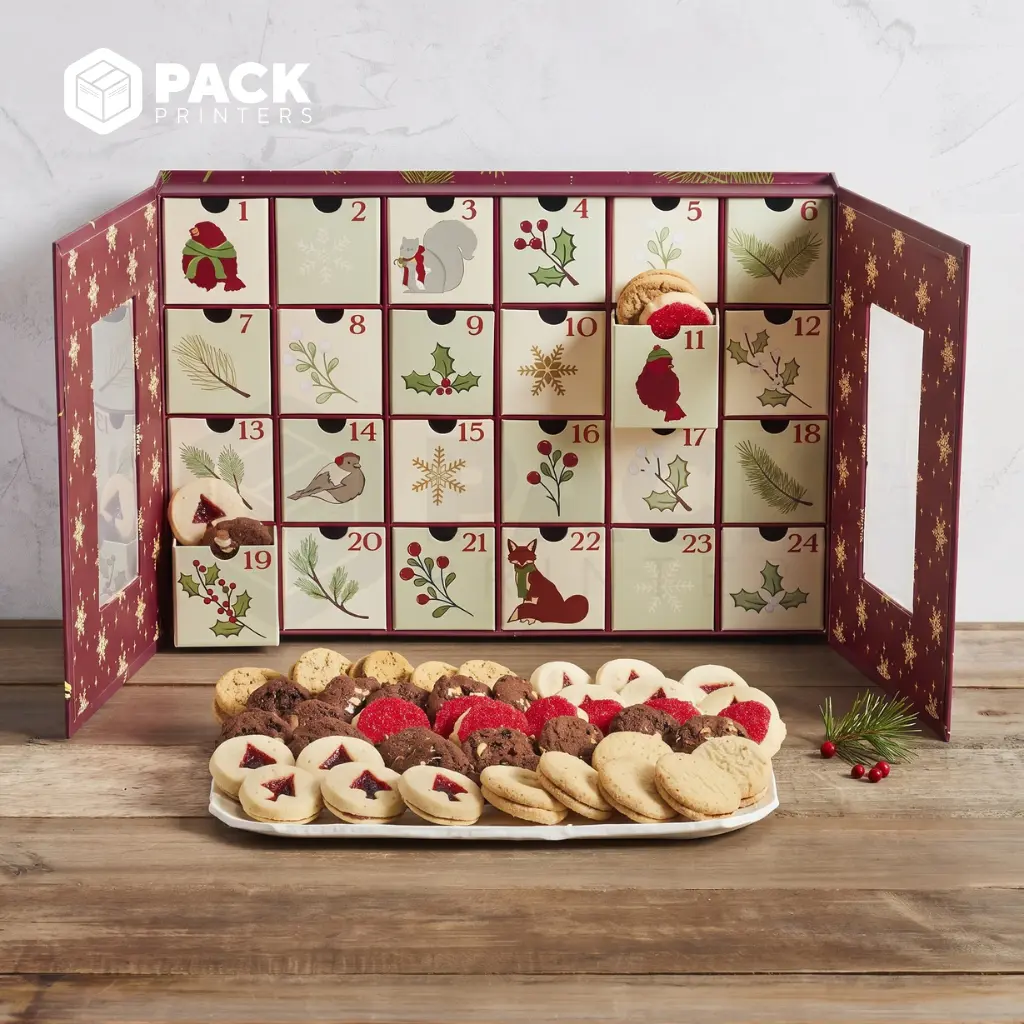
A cookie advent calendar has to survive something a chocolate or trinket calendar never deals with: the cookie sitting sealed in that cell for weeks, pressed against the cardboard, before anyone actually eats it. Pack Printers builds custom cookie advent calendar boxes in a minimum order of just 100 units, specced around the two things generic advent calendar listings wave away as “food safe”: what the cookie is actually touching, and whether it can come back out of its cell without cracking. Here’s what’s genuinely different about packaging cookies into a 24-day countdown.

Get a Quote

Product Description

What Makes a Cookie Advent Calendar Boxes Different

Most advent calendar contents, beauty minis, jewelry, small toys, arrive already packaged in their own container. A cookie usually doesn’t. It sits directly in a cardboard cell, often baked and packed weeks before December 1st, and stays there until the day its door gets opened, sometimes as late as December 24th. That’s a six-to-eight-week dwell time against a printed surface, which is a fundamentally different problem than packaging something that’s already sealed.

The Shelf-Life Problem Nobody Plans For

“Food safe material” on a spec sheet answers whether the board is allowed to touch food. It doesn’t answer whether a cookie sitting against that board for six weeks will still taste fresh on day twenty, or whether butter in the recipe will leave a grease stain working its way through to the printed exterior over that same stretch.

  • Individually sealing each cookie solves most of this: heat-sealing individual cookies in a clear food-safe bag before they go into the cell is the most reliable way to hold freshness across the full countdown window, rather than relying on the box alone.
  • A liner tray matters even with sealed cookies: a separate food-safe tray or liner between the cookie and the printed board keeps grease from migrating into the artwork and keeps ink entirely off the food-contact surface.
  • FDA food-contact compliance still applies: boards and inks in direct contact with food need to meet FDA requirements for food contact substances under 21 CFR 176.170; if cookies are heat-sealed in a liner rather than touching bare board, that liner is what needs the food-contact rating, not necessarily the printed exterior.

Door Size Isn’t Just About Seeing the Cookie

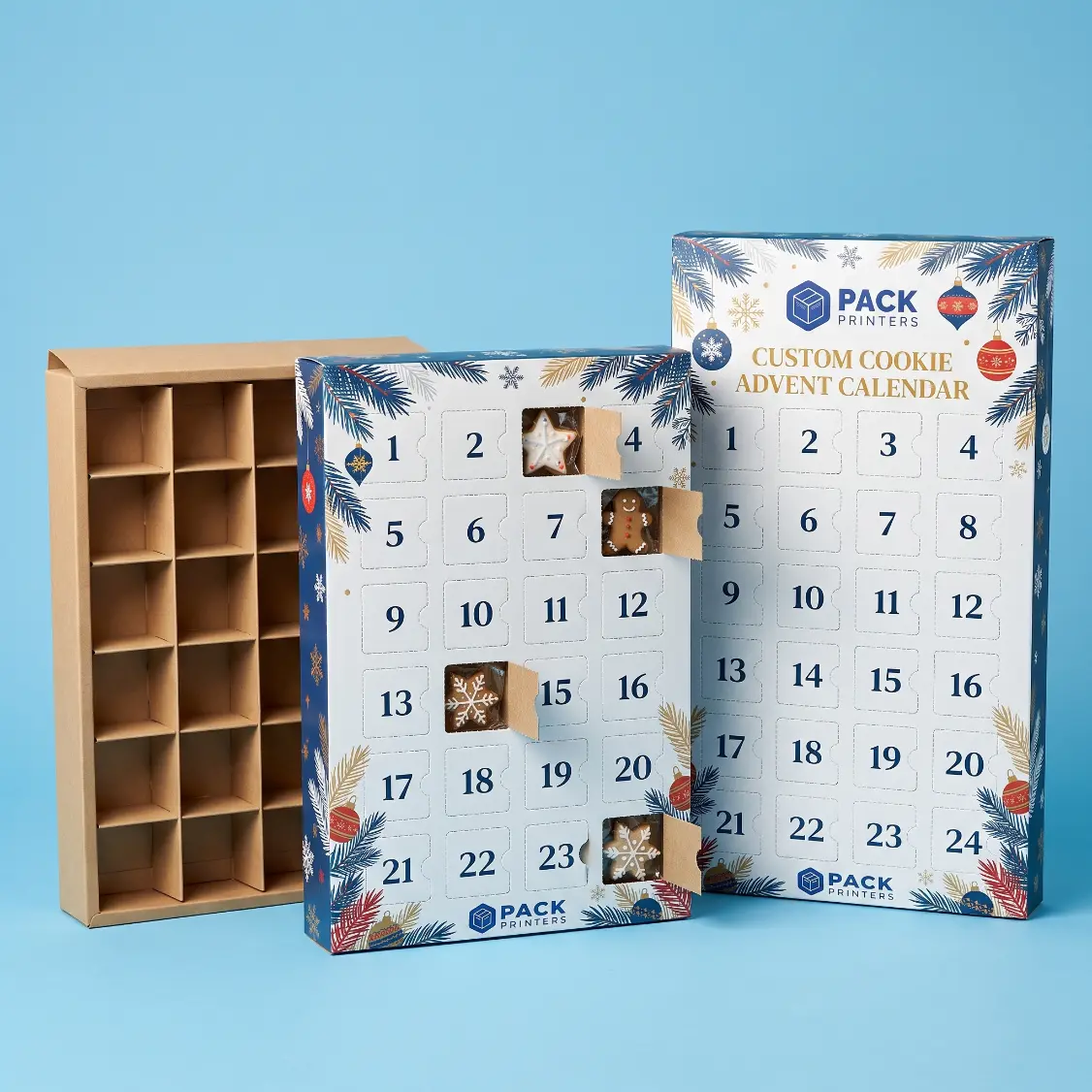
Every advent calendar door needs to be large enough to view what’s inside. A cookie calendar needs something most other calendars don’t: a door opening wide enough to actually remove a rigid, breakable item without scraping it against the die-cut edge on the way out. A chocolate can flex slightly or is small enough to tip out easily. A mini cookie is firm, brittle, and exactly the shape and size most likely to chip against a narrow opening if the door was sized purely for visibility rather than extraction.

As a practical guide, a door opening should clear the cookie’s widest point by enough margin for fingers to get a grip without forcing it through at an angle, not just a snug visual fit.

Sizing Cavities to Your Actual Cookie

Cookie Size
Typical Cavity Size
2″ to 2.25″ mini cookies
2.5″ x 2.5″ x 1″ deep
3″ standard cookies
3.5″ x 3.5″ x 1.25″ deep
Custom or decorated shapes
Sized to the widest point plus clearance, not a generic standard

Decorated cookies with icing or toppings need cavity depth measured from the tallest decorated point, not the flat cookie base, or the lid will press down on the decoration during the weeks it sits in the cell.

The Structural Basics Still Apply

A cookie advent calendar is still a door-style or drawer-style structure underneath, which means the same hinge grain direction and perforation tension considerations that apply to any advent calendar apply here too. We test a physical sample door before production on every advent calendar we build, cookie or otherwise, since a flat proof can’t show you how a door actually opens or how a cookie actually comes out of it.

Materials

Component
Typical Spec
Outer structure
16pt to 18pt SBS coated board
Food-contact liner or tray
FDA-compliant under 21 CFR 176.170, sized to individual cavities
Cookie wrap (recommended)
Clear, food-safe heat-seal bags sized to your cookie

Low Minimum of Just 100

Our minimum is 100 units, low enough for a bakery or small brand to test a cookie advent calendar before committing to full seasonal production.

How to Order

  1. Tell us about your cookie: share your cookie’s size at its widest point, decoration height, and target quantity.
  2. Get a cavity and freshness recommendation: we recommend cavity size, door clearance, and whether a liner tray or individual sealing fits your production timeline.
  3. Test extraction clearance: we check that a cookie the size of yours actually fits through the door without scraping, not just that it looks right in the cell.
  4. Production and quality control: your calendar runs with hinge grain direction and perforation tension checked, at a minimum order of 100 units.
  5. Shipping: your finished cookie advent calendars ship in time for your baking and fulfillment schedule.

Build for Week Six, Not Just Day One

A cookie advent calendar has to protect something that sits in place for weeks and still needs to come out in one piece. Pack Printers specs for both, starting at just 100 units.

Contact Pack Printers today for your custom cookie advent calendar quote, built around your actual cookie, not a generic cavity.

Frequently Asked Questions

We recommend it. A cookie can sit in its cell for six weeks or more before its door is opened, and individual heat-sealing holds freshness across that window far more reliably than the outer box alone.
It’s better not to, even with food-safe board. A separate liner or tray keeps grease from migrating into the printed artwork over the weeks the cookie sits in place, and keeps ink entirely off the food-contact surface.
Usually because the door opening was sized to look right with the cookie inside, not to actually extract it. A rigid, brittle cookie needs clearance at its widest point to come out without scraping the die-cut edge, which is a different sizing question than simple visibility.
From the tallest decorated point, not the flat cookie base. A cavity sized only to the cookie’s footprint can press the lid down onto icing or toppings during the weeks it sits in the calendar.
100 units, low enough for a bakery or small brand to test the format before a full seasonal production run.

Our Free Services

Free Design Support

Free Custom Box Dieline

Free Shipping

Related Products

Get a Quote

Box Information
Personal Information