
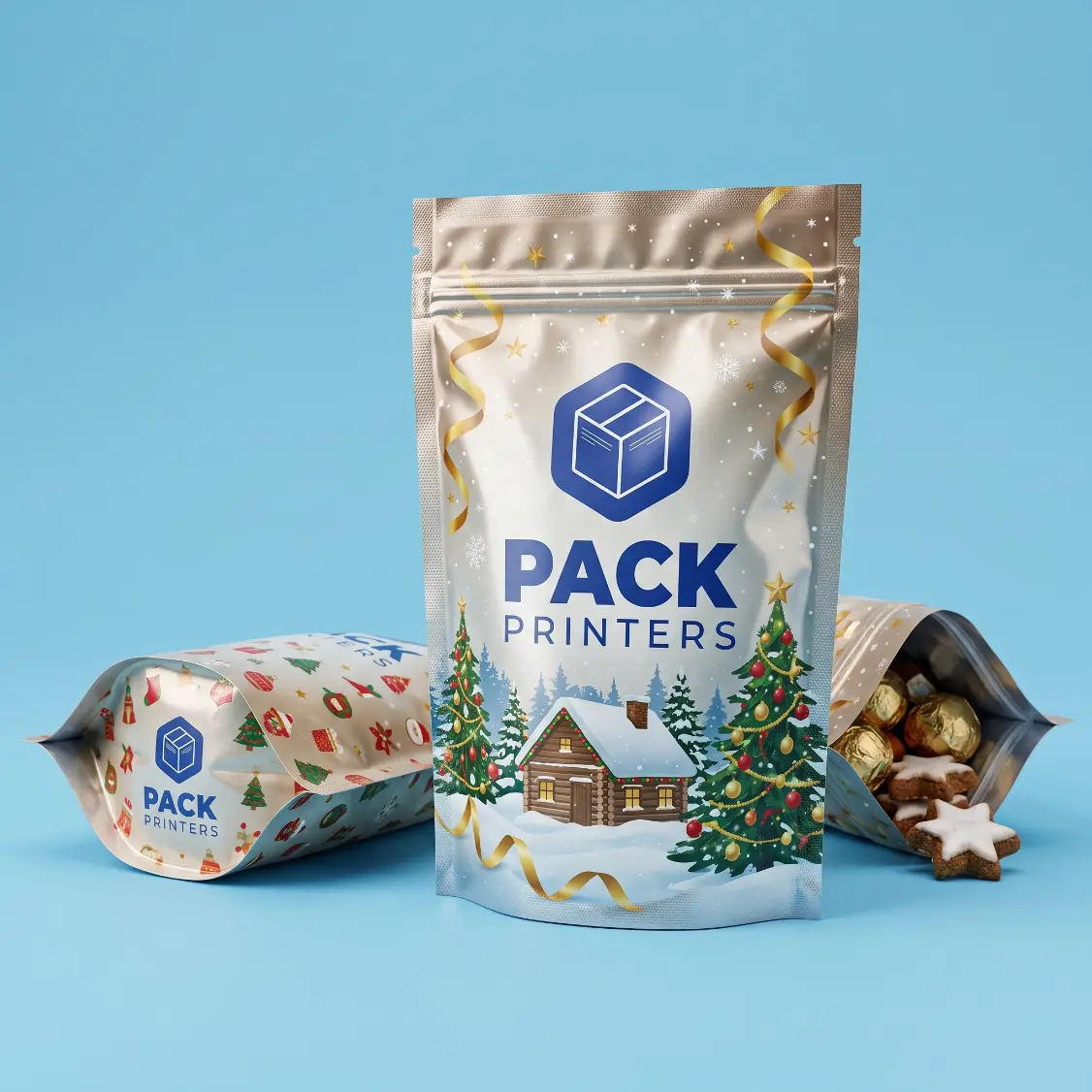
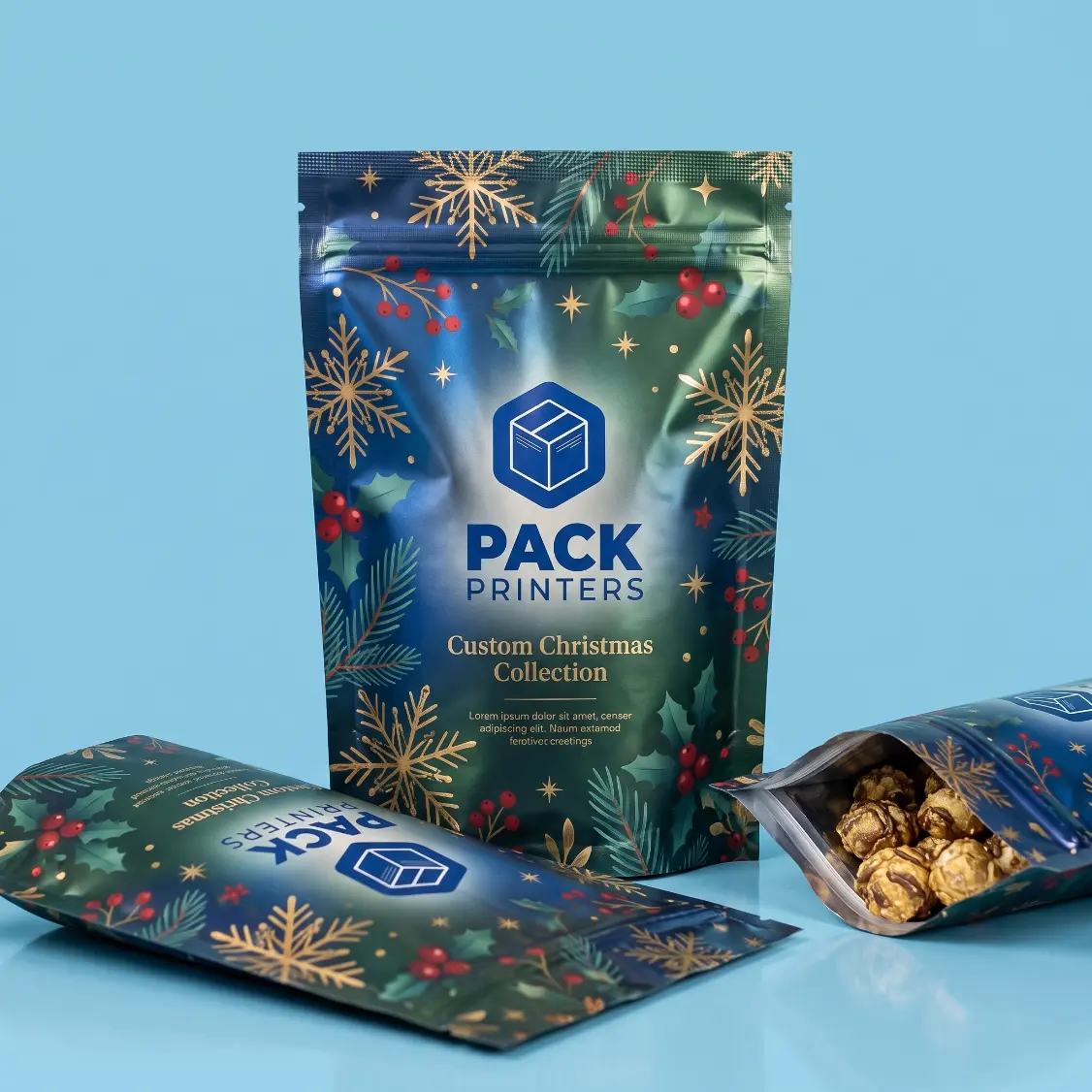
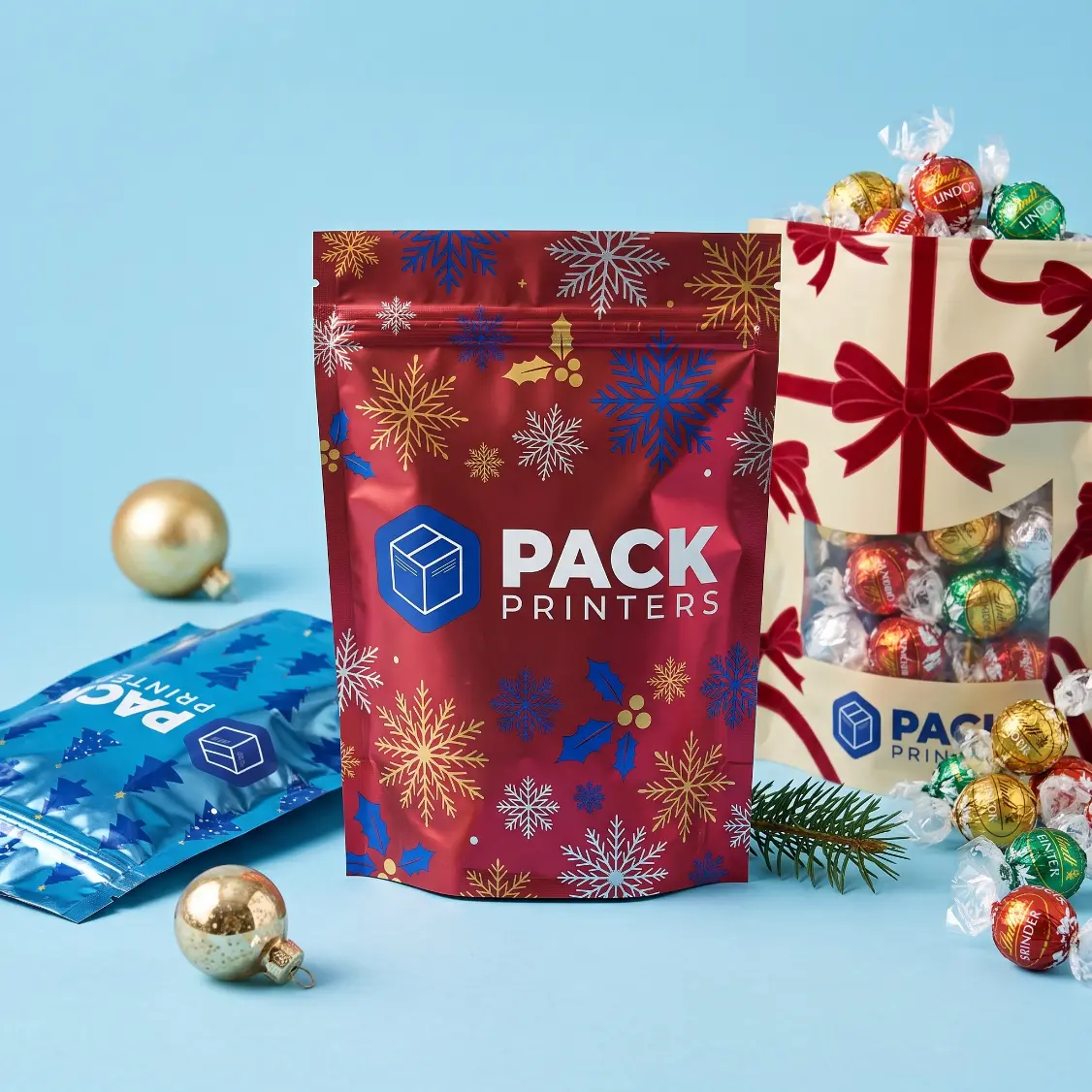
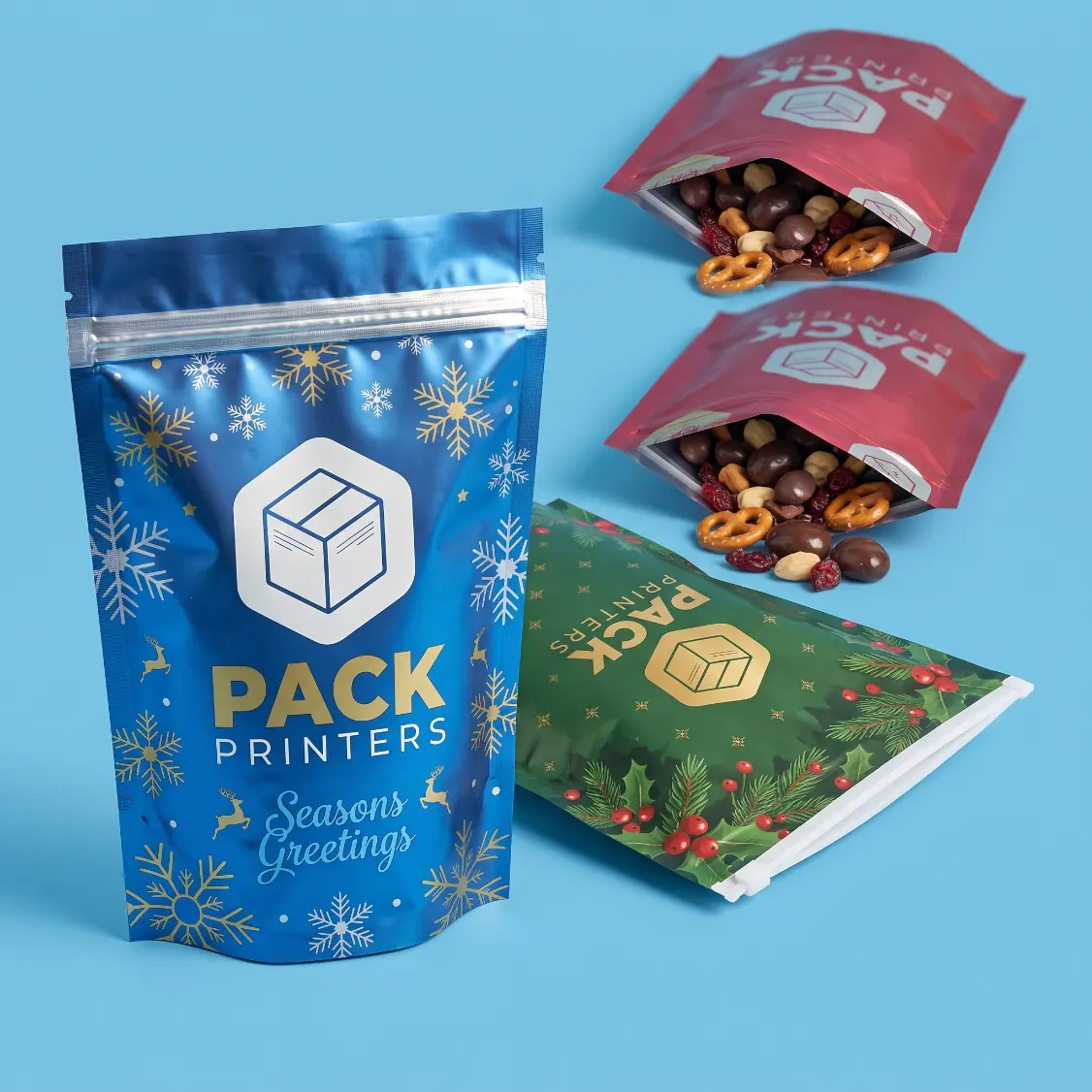
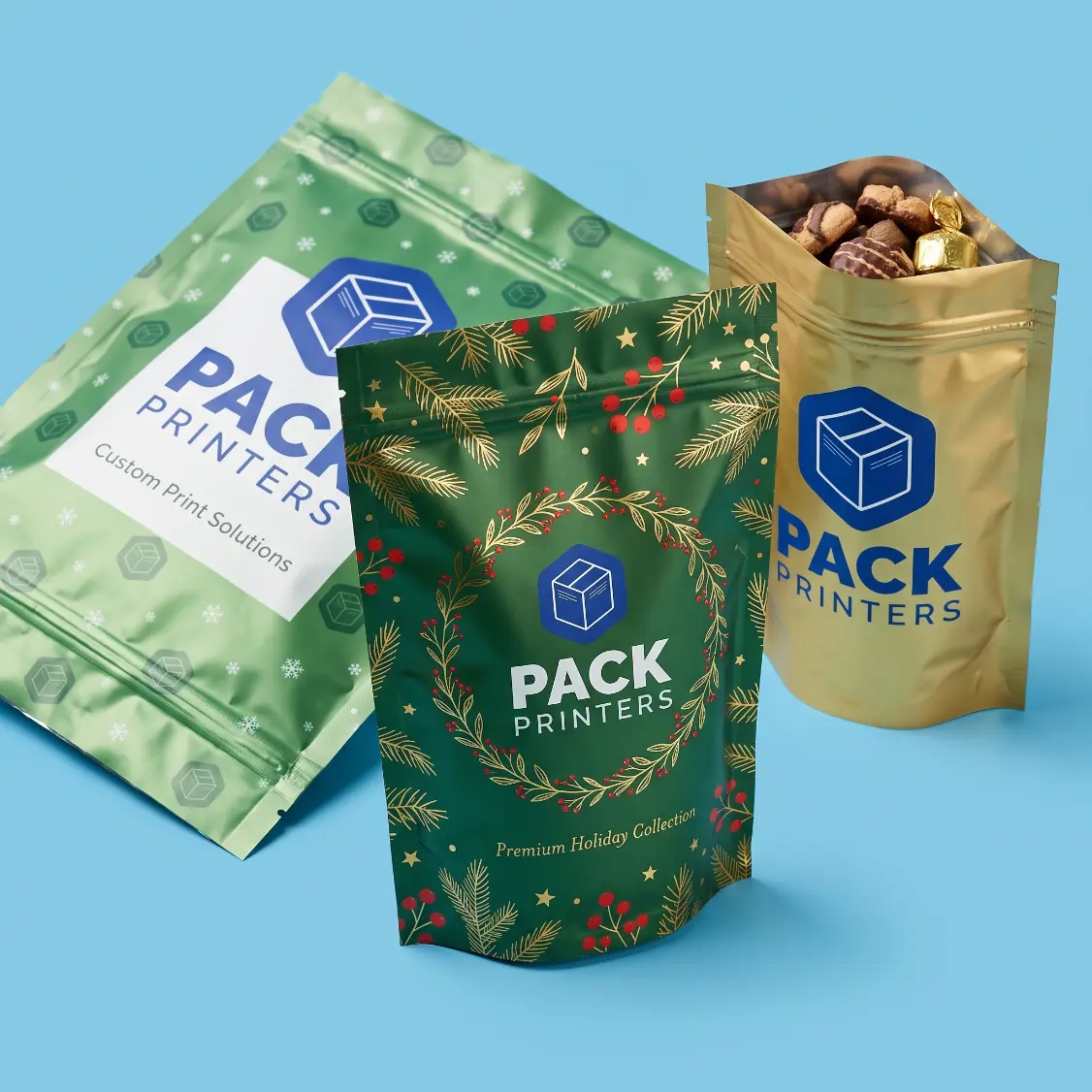
A Christmas mylar bag is a flexible pouch made from laminated barrier film, typically a combination of polyester (PET), a metalized or foil barrier layer, and a heat-sealable polyethylene (PE) inner liner, printed with holiday artwork and used to package treats, gifts, and seasonal products. “Mylar” technically refers to a brand of BoPET polyester film, but in the packaging industry the term is used generally for any metalized or foil-laminated flexible pouch, whether the barrier layer is aluminum foil, metalized PET (VMPET), or a clear high-barrier laminate.
Christmas mylar bags are used across a wide range of holiday products: cookies and candy, popcorn and snack mixes, hot cocoa bombs, coffee and cocoa, cannabis flower and edibles, bath bombs and soap, and small retail gifts and party favors. What they have in common is a need to stay fresh, look good on a shelf or under a tree, and survive handling between production and the customer’s hands.
Wrapping paper and thin poly bags look festive for about a day. Mylar’s laminated structure blocks oxygen, moisture, and light, the three things that cause baked goods to go stale, chocolate to bloom, popcorn to go soft, and cannabis flower to lose potency and aroma. A properly specified mylar bag protects flavor and texture for weeks, which matters when your product is made in November for a December delivery window.
The metalized or foil layer also blocks light, which matters more than most buyers expect. Light exposure degrades fats, oils, and, in cannabis products, cannabinoids, even inside a sealed bag if the film is clear. A foil-backed or opaque mylar bag protects against this in a way a clear poly bag or printed paper simply cannot.
Christmas mylar bags come in a handful of core formats. The right one depends on the product’s weight, shape, and how it will be displayed.
A simple flat bag, sealed on two or three sides, that lies flat until filled. This is the most economical format and works well for cookies, bark, small candies, and gift card holders. A 3-side seal gives a slightly larger fill opening and a cleaner top seal after filling.
Built with a gusseted, W-shaped or K-sealed bottom that lets the bag stand upright on a shelf or under a tree. This is the format most buyers picture when they think of a retail mylar bag, and it is the strongest choice for shelf presence in a store or at a holiday market.
Gussets fold inward on the left and right sides, giving the bag a wider profile once filled while staying compact and flat when empty. A good fit for bulkier products like popcorn or trail mix where volume matters more than a flat-bottom stand.
A premium format with a flat, box-like base that combines pouch flexibility with the shelf stability of a box. This is the format most often used for higher-end coffee, cocoa, and gifting products where presentation is the priority.
Sizing a mylar bag correctly matters more than most first-time buyers expect. A bag that is too large leaves excess headspace, which speeds up staling from trapped air; a bag that is too small stresses the seal during filling. Here are the sizes we produce most often for holiday products:
Bag Size (approx.) |
Typical Fill |
Common Holiday Use |
3″ x 4″ |
1 to 3.5 grams |
Cannabis samples, small candy, party favors |
4″ x 6″ |
0.25 to 0.5 oz (7 to 14 g) |
Cannabis flower, small edibles, spice blends |
6″ x 9″ |
1 oz (28 g) |
Edibles, gourmet snacks, coffee samples |
6″ x 9.5″ (stand-up, 3.5″ gusset) |
4 to 8 oz |
Popcorn, granola, trail mix, hot cocoa bombs |
7″ x 12″ (side-gusset, 4″ gusset) |
1 to 2 lb |
Bulk popcorn, cookies, candy assortments |
Custom sizes |
As specified |
Gift sets, multi-item bundles, retail display packs |
Thickness is measured in mils, thousandths of an inch, and covers the full laminate: the outer PET film, the barrier layer, and the inner sealant. Thicker is not automatically better, it is about matching the film to the product and the storage window. This is the specification competitors rarely explain clearly, so here is the guide we actually use when a customer asks which thickness to choose:
Thickness |
Best For |
What You Get |
2.5 to 3 mil |
Light retail items, short shelf life, party favors |
Lower cost, adequate barrier for products sold and consumed within weeks |
3.5 to 4 mil |
Standard retail food, candy, cannabis flower and pre-rolls |
Good barrier-to-cost balance; the most common thickness for holiday retail bags |
4.5 to 5 mil |
Cannabis, premium coffee, high-value gifting products |
Stronger odor and moisture barrier, better puncture resistance for shipping |
7 to 7.5 mil |
Long-term storage, premium and bulk formats |
Maximum barrier and durability; heaviest feel in hand, often used for gift sets |
As a rule of thumb: 3.5 mil is the standard choice for most Christmas retail bags. Step up to 4.5 to 5 mil for cannabis products, where odor control and state compliance are part of the specification, and for anything shipping directly to a customer’s door, where rough handling in transit is more likely than on a store shelf.
Our Christmas mylar bags are built from a laminated structure, typically PET on the outside for print quality and scratch resistance, a metalized PET (VMPET) or aluminum foil layer in the middle for barrier performance, and a polyethylene (PE) inner layer that creates the heat seal and contacts the product. The PE layer is what makes the bag food-grade, since it is the only layer touching your product, and it complies with FDA regulations for indirect food contact materials under 21 CFR 177.1630 and 21 CFR 177.1520.
For cannabis products, we build to state packaging requirements, including opaque or foil-finish film to block light-driven cannabinoid degradation and child-resistant closures where required. Tell us your state and product category and we will confirm the correct specification before production.
Christmas packaging lives or dies on how it looks under store lighting and in gift photos, so finish selection matters as much as artwork. We print in full-color CMYK with the following finish options:
Category |
Examples |
Baked goods and candy |
Cookies, fudge, bark, candy canes, chocolate-covered treats |
Snacks |
Popcorn, trail mix, roasted nuts, pretzel mixes |
Hot cocoa and coffee |
Hot cocoa bombs, cocoa mix, holiday-blend coffee, cider mix |
Cannabis and edibles |
Flower, pre-rolls, gummies, infused chocolates (where legal) |
Bath and body |
Bath bombs, bar soap, bath salts, gift-set minis |
Small gifts and favors |
Ornaments, stocking stuffers, party favors, gift card holders |
Christmas packaging is one of the few product categories with a hard deadline attached. Order too late and your bags arrive after the selling window closes; order too early relative to your artwork and you risk locking in a design before it is ready. As a general guide, plan for artwork finalization, proofing, production, and freight to take several weeks combined, and build in extra time if you need child-resistant certification, a new custom size, or a first-time material approval. Ordering in late summer or early fall consistently gets better pricing and more flexible production slots than a November order placed under deadline pressure.
Pack Printers builds Christmas mylar bags around your product and your selling season, not a generic seasonal template. Send us your product, target size, and branding goals, and our team will recommend the material, thickness, and closure that will actually hold up between now and the last day of your holiday selling window.
Contact Pack Printers today for a free consultation and custom quote on your Christmas mylar bag project.
Free Design Support
Free Custom Box Dieline
Free Shipping
